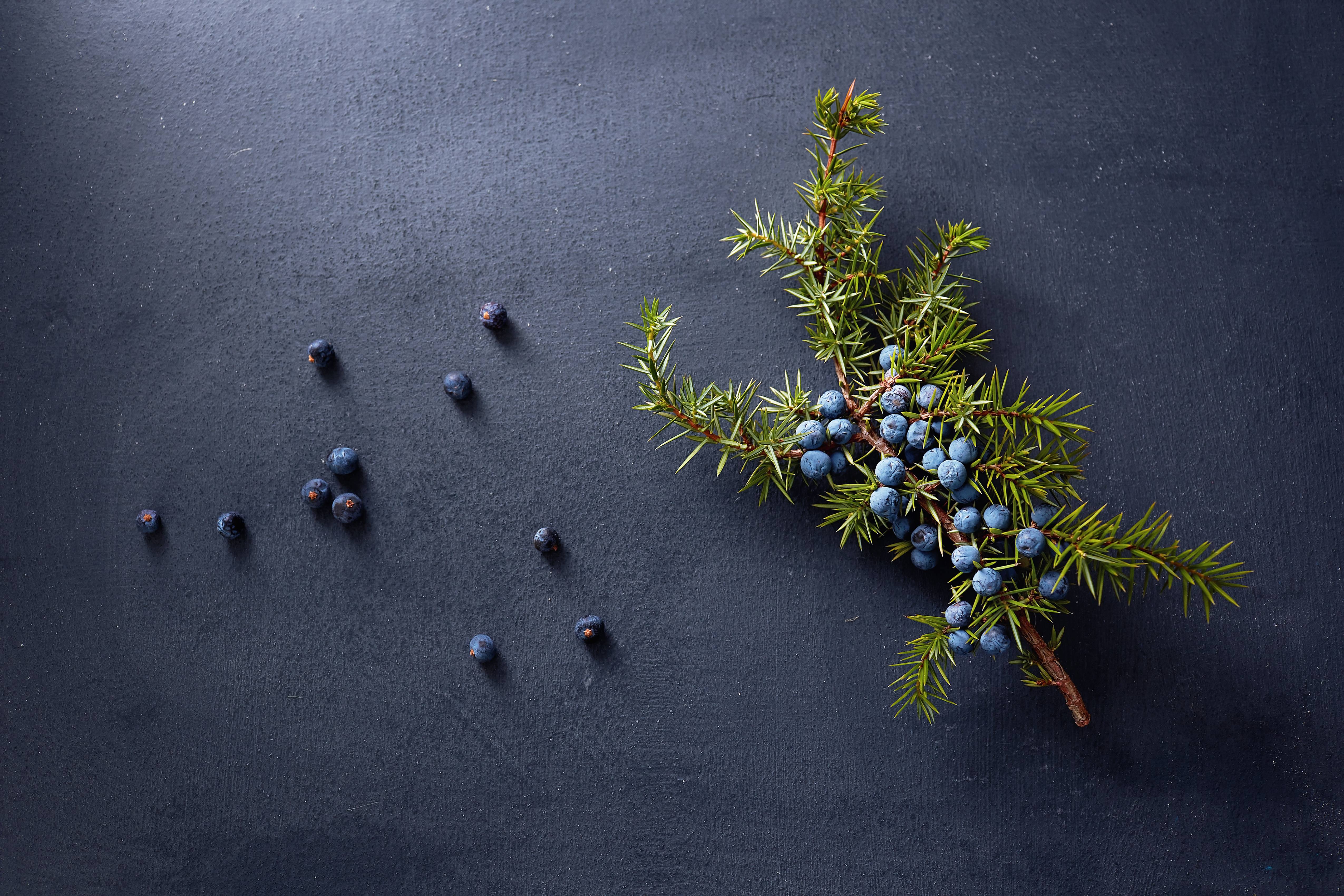
A recipe for an award winning English barleywine aged in gin barrels
An Opportunity
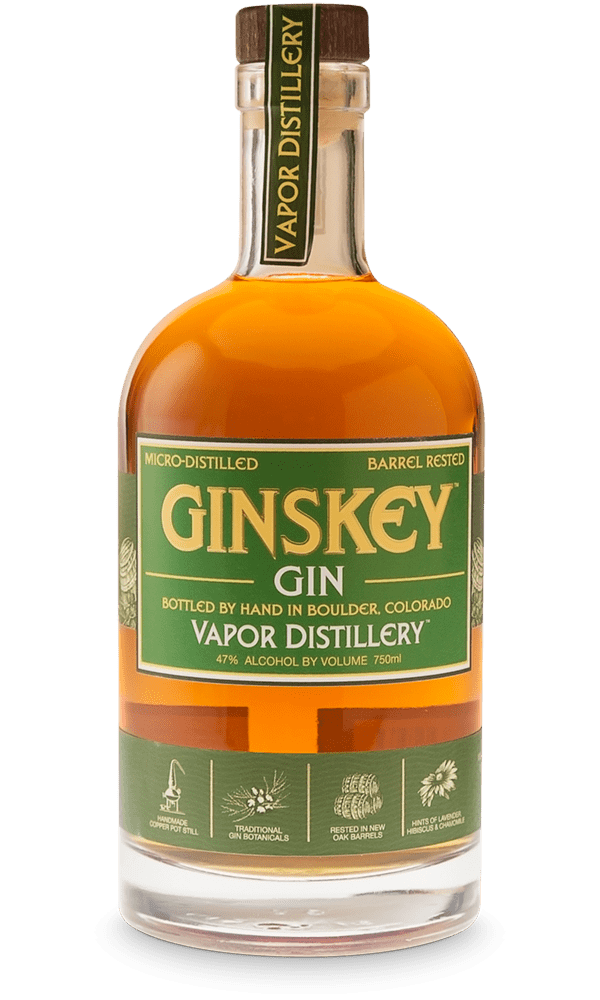
In March of 2015 I received a group email from my friend Todd, he was trying to put together a group buy for some 15 gallon barrels. Only there was a slight twist: these barrels were oak casks that had gin resting in them. To date, I’d only ever tried a Double IPA (DIPA) in a gin barrel, but I had fond memories of that beer, so I jumped at the chance to purchase my own barrel. The barrel came from a local distillery, Roundhouse Spirits in Boulder, Colorado. They’ve since changed their name to Vapor and their barrel aged gin to “Ginskey.”
Marrying Barrel to Base
DIPA was a natural fit for the barrel. After all I had experienced a good gin-enhanced DIPA before, so I knew it could work. But IPAs tend to age so poorly, and I’d likely need to make a more caramel heavy, almost American barleywine base in order to ensure the aged beer that came out of the barrel did not fare poorly. I considered an American barleywine, and dry hopping it post-barrel to add some fresh hop presence in the finished product. But this hop-forward style wouldn’t likely age particularly well, and I was unlikely to go through the batch in the first year. I wanted a beer that would still taste good during years 2, 3 and 4.
A doppelbock was also briefly considered. The maltiness of that beer could go really well with the spirit and its botanicals. But doppelbocks aren’t usually large enough to stand up well to barrel aging. Barrels tend to thin a beer out. And it would be difficult to appropriately hop a doppelbock for barrel aging, to not have it come out a sweet, thin mess.
So I cast my eye towards something a bit larger, a bit heavier. Yet an imperial stout would not do; the roasted malts are too likely to clash with the sharp juniper-heavy botanical flavors of the gin. I considered a big Belgian tripel , and while there is risk between the sharp yeast flavors and the gin flavors clashing, it could’ve worked well. But after considering all those styles, an English barleywine seemed like the obvious pick. It has the body to stand up to a barrel, the flavor to work well with, but not outshine the gin, and it is one of the best styles of beer to age.
Recipe Formulation
My prior English barleywines were usually 100% base malt (Maris Otter or Golden Promise), modeled after the old dusty bottles of JW Lees or Thomas Hardy’s that I’d find neglected on the shelves of local liquor stores in the Chicago area. They usually featured a single hop (Kent Goldings were always a favorite of mine) and they took several years to really come into their own.

But for this beer, I didn’t want to wait several years. I wanted to enjoy it within the first year. I had good experiences brewing Belgian quadrupels that could taste really good when young by adding some crystal and dark malt complexity to the grain bill. And Belgian quadrupels are basically the Belgian equivalent to English barleywine, so I scoured some of my brewing books for inspiration and got to work on a recipe. The closest recipe to this one is probably Gordon Strong’s Draft Dodger on page 3 of his Brewing Better Beer book. While the base malt and hopping is different, the influence of his supporting malts is obvious when you compare the recipes. It’s designed to drink with good complexity within a year of brew day. And while it should age well for years to come, with less than 40 IBUs, my recipe was always destined to become quite sweet after a couple of years of hop degradation.
The barrel, which is an ingredient in this recipe in its own right, is only 15 gallons. That means the ratio of surface area in contact with the beer to volume is large. The flavors of the barrel will incorporate themselves into the beer faster compared to a traditional 53 gallon bourbon barrel or 60 gallon wine barrel. I planned for about 6 months of barrel aging with this beer, but these things are always best done by taste, so we started tasting samples at month 4. The beer eventually came out of the barrel after 8 months.
Partnership
I partnered up with Nathan, my usual brewing buddy, to brew this beer. We often made big beers together and were used to splitting 5 gallon batches. Neither of us really wanted 7.5 gallons each, so we brought in Adam, my friend, to take a one-third share.
Mistakes Were Made
One of my cardinal rules of barrel aging on a homebrew scale is to always have the liquid fermented and ready to transfer into the barrel when you purchase the barrel. I did not have this rule in 2015, and violated it routinely back then. I’ve often tried to mimic what larger, well reputed breweries do and some of the best clean barrel programs in the world routinely violate this rule. But they also have far better sanitation procedures, testing capabilities and other safeguards (and they still dump plenty of beer that goes bad in the barrel!).
The other mistake that I made with this batch was not adding a bottling yeast when we bottle conditioned this beer. We figured enough residual yeast was still left in the beer, since we didn’t filter it. But the combination of a 13.5%+ ABV beer and 8+ months after the yeast pitched meant that there wasn’t anything left that could carbonate the sugar that we added to the batch. In hindsight, this was a silly mistake, but I hadn’t bottle conditioned many big beers to this point.
Somehow, both mistakes did not burn us. The barrel/beer never soured, no wild yeast contaminated the batch. However, when we checked the beer two months after bottling, it had absolutely zero carbonation. We were able to recover by adding a few granules of fresh Fermentis S-04 active dry yeast (the primary fermentaion strain) to each bottle and recapping with fresh caps. (A bottling strain like Lalbrew CBC-1 or Fermentis EC-1118 would have done too.) Roughly six weeks later, the bottles were carbonated. Crisis averted!
Flavors and Medals
When we primed the beers for refermentation, Adam didn’t want his share carbonated because he enjoyed it as-is, still. He’d grown accustomed to little to no carbonation and higher beer serving temperatures during his time living in the UK and drinking cask ales. So he drank uncarbed 13.5% barleywine at room temperature (ironically he also went through his share within 6 months!).
The flavors in the final beer were delicious. It was initially juniper-heavy, but also had some great vanilla depth from the oak barrel. It was all held together by some thick caramel, dark fruit and bready toast flavors from the malt. It was decadent, but not too sweet.
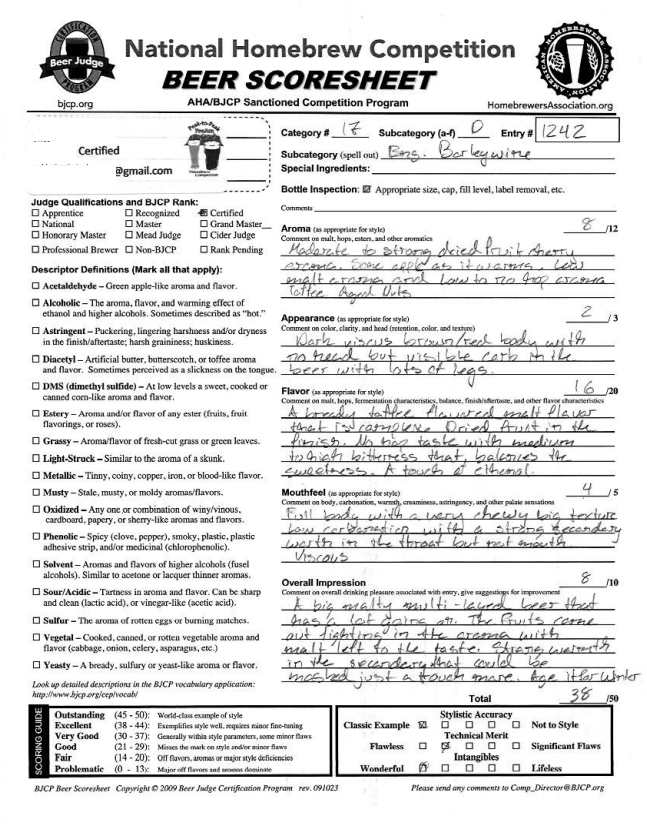
We entered the beer into three different competitions, all in the specialty wood category, when it was anywhere from 10-24 months old. The beer was entered into the 2016 Peak to Peak Pro-AM and received 3rd place with a 39 consensus score. At the 2017 Big Beers, Begians and Barleywines Festival in Breckenridge, Colorado, we won a silver medal for this beer. It also scored a 36 at the NHC, but did not move on to the next round.
Comments from the scorecards included descriptors like “caramelized sugar, heavy bread, intense toffee, dark fruit, clover honey, moderate vanilla, molasses on the nose, spicy flavor, thick and syrupy without being too heavy, vanilla from the wood, subtle juniper. Rich, bready, complex flavor, black raison, prune, smooth, intense alcohol, sweet, nutty finish.”
Brewing this Beer
If you want to brew this beer, the toughest part will be acquiring a gin barrel. While craft distilleries have really blown up in the last five years, it’s still rare to see barrel-aged gin. It’s even rarer to find a 10-15 gallon barrel. If you do find a full sized, 53 gallon barrel, expect to age it 10-15 months to replicate the flavors that we did in this beer in eight months. With a 10 gallon barrel, I’d start to check it at month 4, and with a 15 gallon barrel start to check around month 5. Always barrel age to taste, once it’s ready, take it out and package it.

If you cannot find a gin barrel, you can work on substituting with medium toasted oak (spirals work great here) or some charred oak chips. If you char oak chips yourself, make sure to leach out the excess astringency by boiling them in water for 10 minutes before using them. I’d then add 4-8 oz of gin per five gallons of beer to your final beer. I’d pick out a gin that has some good botanical flavor. Gin flavors can vary widely. Go to your local distillery(ies) and check out what is available. If you happen to find a barrel aged gin, you could just use that, and skip the wood, since the gin will inherently have flavors of wood. (You can always add chips to taste if the initial BA gin doesn't give you enough of the wood component.)
On the packaging front, I know we bottle conditioned it so that it could develop over time, but after a few years it got pretty sweet. It was still nice, but I don’t think it was worth the trouble of reconditioning on yeast in the hopes that it would continue to evolve for many years to come. If I brewed this again (unfortunately for me, the distillery now only uses 53 gallon barrels for the gin), I would force carbonate in kegs and bottle it up. It will still mature and taste great for years to come. I think this beer peaked between years 2 and 3, and still tasted good until at least year 5. It has gotten quite sweet (I still have two bottles that I stashed away), but that’s not uncommon at all for an English barleywine.
If you’re looking for something that might not peak until years 3-6, or something that will continue to develop and change for many years to come, consider increasing the bittering hops to 50-60 IBUs and recondition at bottling like we did.
I listed the specific malts that we used in the recipe below. Using malts from other maltsters or using similar malts (e.g. 60L instead of Simpson’s Medium) is totally fine. Substituting hops would be fine too. Magnum or Target would work well as the bittering addition. Fuggles are a suitable hop for flavor. You can explore a bit wider too. The point of the beer is not to have much hop flavor, the hops are primarily there to bitter and balance the big sweet malt flavor.
Fermentis S-04 is what we used and it worked well, but any English yeast capable of fermenting upwards of 13% ABV would work well. White Labs WLP099 Super High Gravity is reportedly the Thomas Hardy’s Ale strain. I’ve used that in other barleywines and in stouts with great success. Make sure to pitch a large amount of healthy yeast. Use the Brewer’s Friend Calculator for pitch rates if you’re unsure.
King Juniper
BREW SHEET · BEERXML
King Juniper
English Barleywine
Download BeerXML- Batch
- 5.00 gal
- OG
- 1.046
- FG
- 1.010
- ABV
- 4.7%
- IBU
- 38.9
- Boil
- 60 min
Fermentables
| Ingredient | Amount | Details |
|---|---|---|
| Pale Malt, Maris Otter (Thomas Fawcett) | 17 lbs | Grain |
| Crystal, Light (Simpsons) | 2 lbs 4.0 oz | Grain |
| Amber Malt (Bairds) | 1 lbs 8.0 oz | Grain |
| Biscuit (Dingemans) | 1 lbs 8.0 oz | Grain |
| Wheat Malt, Pale (Weyermann) | 1 lbs 8.0 oz | Grain |
| Dextrin Malt (Simpsons) | 1 lbs 4.0 oz | Grain |
| Crystal, Medium (Simpsons) | 8.0 oz | Grain |
| Turbinado | 12.8 oz | Sugar |
Hops
| Ingredient | Amount | Addition |
|---|---|---|
| Challenger | 2.25 oz | Boil · 60.0 min · 7.75% alpha acid |
| East Kent Goldings (EKG) | 1.00 oz | Boil · 5.0 min · 5% alpha acid |
Yeast
| Ingredient | Amount | Details |
|---|---|---|
| SafAle English Ale | 23.66 ml | DCL/Fermentis · S-04 |
Mash schedule
- Mash In · 152.0 F · 75 min · 30.17 L infusion
Fermentation
- Primary: 14 days at 19.4 °C
- Secondary: 14 days at 20.6 °C
- Tertiary: 7 days
Full technical details
Original export fields, ingredient specifications, water, style and equipment.
Fermentables
Pale Malt, Maris Otter (Thomas Fawcett)
- Name
- Pale Malt, Maris Otter (Thomas Fawcett)
- Type
- Grain
- Amount (kg / L for liquids)
- 7.7110640
- Yield
- 82.5000000
- Color (SRM)
- 3.0000000
- Add after boil
- FALSE
- Origin
- United Kingdom
- Supplier
- Thomas Fawcett & Sons
- Notes
- Premium base malt from the UK. Popular for many English styles of beer including ales, pale ales and bitters.
- Coarse fine diff
- 1.5000000
- Moisture
- 3.0000000
- Diastatic power
- 120.0000000
- Protein
- 9.4000000
- Max in batch
- 100.0000000
- Recommend mash
- TRUE
- Ibu gal per lb
- 0.0000000
- Display amount
- 17 lbs
- Inventory
- 0.0 oz
- Potential
- 1.0379500
- Display color
- 3.0 SRM
- Extract substitute
- Pale Liquid Extract
Crystal, Light (Simpsons)
- Name
- Crystal, Light (Simpsons)
- Type
- Grain
- Amount (kg / L for liquids)
- 1.0205820
- Yield
- 69.0000000
- Color (SRM)
- 52.8000000
- Add after boil
- FALSE
- Origin
- UK
- Supplier
- Simpsons
- Notes
- Simpson's Crystal Light brings mild caramel and toffee flavours to beers whilst contributing a beautiful golden hue. Its clean, mild sweetness brings depth of flavour to beers where extra body is required, without adding overtly toasted or roasted characters.
- Coarse fine diff
- 1.5000000
- Moisture
- 6.0000000
- Diastatic power
- 0.0000000
- Protein
- 0.0000000
- Max in batch
- 15.0000000
- Recommend mash
- TRUE
- Ibu gal per lb
- 0.0000000
- Display amount
- 2 lbs 4.0 oz
- Inventory
- 0.0 oz
- Potential
- 1.0317400
- Display color
- 52.8 SRM
Amber Malt (Bairds)
- Name
- Amber Malt (Bairds)
- Type
- Grain
- Amount (kg / L for liquids)
- 0.6803880
- Yield
- 75.0000000
- Color (SRM)
- 55.0000000
- Add after boil
- FALSE
- Origin
- United Kingdom
- Supplier
- Bairds
- Notes
- Amber malt has a light, biscuity, dry flavour and can be used to produce some Bitter and Mild Ales and sweet Stouts in the UK, as well as the traditional London Porters that have come back into favour recently. The flavour is quite intense and caution in the use of this material is required.
- Coarse fine diff
- 1.5000000
- Moisture
- 3.5000000
- Diastatic power
- 20.0000000
- Protein
- 11.0000000
- Max in batch
- 20.0000000
- Recommend mash
- FALSE
- Ibu gal per lb
- 0.0000000
- Display amount
- 1 lbs 8.0 oz
- Inventory
- 0.0 oz
- Potential
- 1.0345000
- Display color
- 55.0 SRM
Biscuit (Dingemans)
- Name
- Biscuit (Dingemans)
- Type
- Grain
- Amount (kg / L for liquids)
- 0.6803880
- Yield
- 70.0000000
- Color (SRM)
- 22.5000000
- Add after boil
- FALSE
- Origin
- Belgium
- Supplier
- Dingemans
- Coarse fine diff
- 0.0000000
- Moisture
- 4.5000000
- Diastatic power
- 0.0000000
- Protein
- 11.5000000
- Max in batch
- 15.0000000
- Recommend mash
- TRUE
- Ibu gal per lb
- 0.0000000
- Display amount
- 1 lbs 8.0 oz
- Inventory
- 0.0 oz
- Potential
- 1.0322000
- Display color
- 22.5 SRM
Wheat Malt, Pale (Weyermann)
- Name
- Wheat Malt, Pale (Weyermann)
- Type
- Grain
- Amount (kg / L for liquids)
- 0.6803880
- Yield
- 82.2300000
- Color (SRM)
- 2.0000000
- Add after boil
- FALSE
- Origin
- Germany
- Supplier
- Weyermann
- Notes
- Pale wheat malt, used as a base malt in many wheat styles. Wheat beers, Koelsch, Alts.
- Coarse fine diff
- 1.7000000
- Moisture
- 4.5000000
- Diastatic power
- 74.0000000
- Protein
- 11.7000000
- Max in batch
- 80.0000000
- Recommend mash
- TRUE
- Ibu gal per lb
- 0.0000000
- Display amount
- 1 lbs 8.0 oz
- Inventory
- 0.0 oz
- Potential
- 1.0378258
- Display color
- 2.0 SRM
- Extract substitute
- Wheat Liquid Extract
Dextrin Malt (Simpsons)
- Name
- Dextrin Malt (Simpsons)
- Type
- Grain
- Amount (kg / L for liquids)
- 0.5669900
- Yield
- 67.0000000
- Color (SRM)
- 0.7360406
- Add after boil
- FALSE
- Origin
- Uk
- Supplier
- Simpsons
- Notes
- A handy little tool to keep up your sleeve, Dextrin Malt can be used sparingly to add body, mouthfeel and foam stability to any beer. Particularly useful in very light, hop forward IPAs to balance bitterness. It is great in lower attenuated sweet beers such as Mild and sweet Stout.
- Coarse fine diff
- 1.5000000
- Moisture
- 7.0000000
- Diastatic power
- 0.0000000
- Protein
- 0.0000000
- Max in batch
- 20.0000000
- Recommend mash
- TRUE
- Ibu gal per lb
- 0.0000000
- Display amount
- 1 lbs 4.0 oz
- Inventory
- 0.0 oz
- Potential
- 1.0308200
- Display color
- 0.7 SRM
Crystal, Medium (Simpsons)
- Name
- Crystal, Medium (Simpsons)
- Type
- Grain
- Amount (kg / L for liquids)
- 0.2267960
- Yield
- 69.0000000
- Color (SRM)
- 90.6091371
- Add after boil
- FALSE
- Origin
- UK
- Supplier
- Simpsons
- Notes
- Caramel and toffee notes come to the forefront in Simpsons' Crystal Medium. Their expert roasters use their skills to bring you a crystal that adds stunning deep golden and red hues to your beer, whilst imparting deeper caramel notes.
- Coarse fine diff
- 1.5000000
- Moisture
- 5.0000000
- Diastatic power
- 0.0000000
- Protein
- 0.0000000
- Max in batch
- 15.0000000
- Recommend mash
- TRUE
- Ibu gal per lb
- 0.0000000
- Display amount
- 8.0 oz
- Inventory
- 0.0 oz
- Potential
- 1.0317400
- Display color
- 90.6 SRM
Turbinado
- Name
- Turbinado
- Type
- Sugar
- Amount (kg / L for liquids)
- 0.3628736
- Yield
- 95.7000000
- Color (SRM)
- 10.0000000
- Add after boil
- FALSE
- Origin
- United Kingdom
- Notes
- Light, raw brown sugar. May be used in British pale ales or high gravity Belgian ales. Limit percentage used to avoid undesirable flavors. Similar to Demerara sugar.
- Coarse fine diff
- 1.5000000
- Moisture
- 4.0000000
- Diastatic power
- 120.0000000
- Protein
- 11.7000000
- Max in batch
- 10.0000000
- Recommend mash
- FALSE
- Ibu gal per lb
- 0.0000000
- Display amount
- 12.8 oz
- Inventory
- 0.0 oz
- Potential
- 1.0440220
- Display color
- 10.0 SRM
Hops
Challenger
- Name
- Challenger
- Origin
- United Kingdom
- Alpha acid (%)
- 7.7500000
- Amount (kg / L for liquids)
- 0.0637864
- Use
- Boil
- Time (min)
- 60.0000000
- Notes
- Variant of Northern Brewers heritage Used for: Both aroma and bittering for ales and lagers Aroma: Fruity in flavor, spicy aroma, blends well Substitutes: N/A
- Type
- Aroma
- Form
- Pellet
- Beta
- 4.0000000
- Hsi
- 25.0000000
- Display amount
- 2.25 oz
- Inventory
- 0.00 oz
- Display time
- 60.0 min
East Kent Goldings (EKG)
- Name
- East Kent Goldings (EKG)
- Origin
- United Kingdom
- Alpha acid (%)
- 5.0000000
- Amount (kg / L for liquids)
- 0.0283495
- Use
- Boil
- Time (min)
- 5.0000000
- Notes
- Also known as Canterbury Hops by some, although others will dispute this fact. East Kent Goldings gracefully defines the English Pale Ales and Ales produced by the region, it is quintessentially English. Used for: English Ale, Porter, Scottish and Irish Ale, Stout, Strong Ale, ESB, Saison, Barleywine. Aroma: Floral, aromatic, earthy, slightly sweet spicy flavor Substitutes: First Gold, Fuggles, other Golding varieties, Progress, Target, and Whitbread Golding Storage: Good/Fair 965-80% AA after 6 months at 20 C) 4-7% AA / 1.9-2.8% Beta
- Type
- Both
- Form
- Pellet
- Beta
- 3.5000000
- Hsi
- 35.0000000
- Display amount
- 1.00 oz
- Inventory
- 0.00 oz
- Display time
- 5.0 min
Yeast
SafAle English Ale
- Name
- SafAle English Ale
- Type
- Ale
- Form
- Dry
- Amount (kg / L for liquids)
- 0.0236590
- Amount is weight
- FALSE
- Laboratory
- DCL/Fermentis
- Product id
- S-04
- Min temperature
- 15.0000000
- Max temperature
- 24.0000000
- Flocculation
- Medium
- Attenuation (%)
- 73.0000000
- Notes
- Fast starting, fast fermenting yeast. Quick attenuation helps to produce a clean, crisp, clear ale. Can be used in a wide range of ales.
- Best for
- Great general purpose ale yeast.
- Max reuse
- 5
- Times cultured
- 0
- Add to secondary
- FALSE
- Display amount
- 23.66 ml
- Disp min temp
- 59.0 F
- Disp max temp
- 75.2 F
- Inventory
- 0.0 pkg
- Culture date
- 14 Jun 2003
Mash
- Name
- Single Infusion, Light Body, No Mash Out
- Grain temp
- 22.2222222
- Tun temp
- 22.2222222
- Sparge temp
- 75.5555556
- Ph
- 5.4000000
- Tun weight
- 152.0000000
- Tun specific heat
- 0.3000000
- Equip adjust
- TRUE
- Notes
- Simple single infusion mash for use with most modern well modified grains (about 95% of the time).
- Display grain temp
- 72.0 F
- Display tun temp
- 72.0 F
- Display sparge temp
- 168.0 F
- Display tun weight
- 9 lbs 8.0 oz
Mash In
- Name
- Mash In
- Type
- Infusion
- Infusion water (L)
- 30.1651740
- Step time (min)
- 75.0000000
- Step temperature (°C)
- 66.6666667
- Ramp time
- 2.0000000
- End temp
- 66.6666667
- Description
- Add 31.88 qt of water at 167.1 F
- Water grain ratio
- 1.250 qt/lb
- Decoction amt
- 0.00 qt
- Infuse temp
- 167.1 F
- Display step temp
- 152.0 F
- Display infuse amt
- 31.88 qt
Recipe details & fermentation
- Name
- King Juniper
- Type
- All Grain
- Brewer
- Ryan Pachmayer and Nathan Rooen
- Batch size (L)
- 18.9271680
- Boil size (L)
- 25.4728136
- Boil time (min)
- 60.0000000
- Efficiency (%)
- 65.0000000
- Taste rating
- 30.0000000
- Original gravity
- 1.0460000
- Final gravity
- 1.0100000
- Carbonation
- 2.3000000
- Fermentation stages
- 2
- Primary duration (days)
- 14.0000000
- Primary temperature (°C)
- 19.4444444
- Secondary duration (days)
- 14.0000000
- Secondary temperature (°C)
- 20.5555556
- Tertiary duration (days)
- 7.0000000
- Conditioning duration (days)
- 5.0000000
- Conditioning temperature (°C)
- 0.5555556
- Carbonation used
- Bottle with 3.53 oz Corn Sugar
- Forced carbonation
- TRUE
- Priming sugar name
- Corn Sugar
- Priming sugar equiv
- 1.0000000
- Keg priming factor
- 0.5000000
- Carbonation temp
- 21.1111111
- Display carb temp
- 70.0 F
- Date
- 04 May 2021
- Est og
- 1.128 SG
- Est fg
- 1.029 SG
- Est color
- 25.4 SRM
- IBU
- 38.9 IBUs
- Ibu method
- Tinseth
- Est abv
- 13.3 %
- ABV (%)
- 4.7 %
- Actual efficiency
- 21.0 %
- Calories
- 151.6 kcal/12oz
- Display batch size
- 5.00 gal
- Display boil size
- 6.73 gal
- Display og
- 1.046 SG
- Display fg
- 1.010 SG
- Display primary temp
- 67.0 F
- Display secondary temp
- 69.0 F
- Display tertiary temp
- 65.0 F
- Display age temp
- 33.0 F
Style details
- Name
- English Barleywine
- Category
- Strong British Ale
- Category number
- 17
- Style letter
- D
- Style guide
- BJCP 2015
- Type
- Ale
- Og min
- 1.0800000
- Og max
- 1.1200000
- Fg min
- 1.0180000
- Fg max
- 1.0300000
- Ibu min
- 35.0000000
- Ibu max
- 70.0000000
- Color min
- 8.0000000
- Color max
- 22.0000000
- Carb min
- 1.6000000
- Carb max
- 2.6000000
- Abv max
- 12.0000000
- Abv min
- 8.0000000
- Notes
- A showcase of malty richness and complex, intense flavors. Chewy and rich in body, with warming alcohol and a pleasant fruity or hoppy interest. When aged, it can take on port-like flavors. A wintertime sipper. History: Strong ales of various formulations have long been brewed in England, and were known by several names. The modern barleywine traces back to Bass No. 1, which was first called a barleywine in 1872. Barleywines were darker beers until Tennant (now Whitbread) first produced Gold Label, a gold-colored barleywine in 1951. Usually the strongest ale offered by a brewery, and in recent years many commercial examples are now vintage-dated and offered as a limited-release winter seasonal specialty. The original barleywine style that inspired derivative variations in Belgium, the United States, and elsewhere in the world. Style Comparison: Although often a hoppy beer, the English Barleywine places less emphasis on hop character than the American Barleywine and features English hops. English versions can be darker, maltier, fruitier, and feature richer specialty malt flavors than American Barleywines. Has some overlap British Old Ale on the lower end, but generally does not have the vinous qualities of age; rather, it tends to display the mature, elegant signs of age.
- Profile
- Aroma: Very rich and strongly malty, often with a caramel-like aroma in darker versions or a light toffee character in paler versions. May have moderate to strong fruitiness, often with a dark- or dried-fruit character, particularly in dark versions. The hop aroma may range from mild to assertive, and is typically floral, earthy, or marmalade-like. Alcohol aromatics may be low to moderate, but are soft and rounded. The intensity of these aromatics often subsides with age. The aroma may have a rich character including bready, toasty, toffee, and/or molasses notes. Aged versions may have a sherry-like quality, possibly vinous or port-like aromatics, and generally more muted malt aromas. Appearance: Color may range from rich gold to very dark amber or even dark brown (often has ruby highlights, but should not be opaque). Low to moderate off-white head; may have low head retention. May be cloudy with chill haze at cooler temperatures, but generally clears to good to brilliant clarity as it warms. The color may appear to have great depth, as if viewed through a thick glass lens. High alcohol and viscosity may be visible in “legs” when beer is swirled in a glass. Flavor: Strong, intense, complex, multi-layered malt flavors ranging from bready, toffee, and biscuity in paler versions through nutty, deep toast, dark caramel, and/or molasses in darker versions. Moderate to high malty sweetness on the palate, although the finish may be moderately sweet to moderately dry (depending on aging). Some oxidative or vinous flavors may be present, and often complex alcohol flavors should be evident. Moderate to fairly high fruitiness, often with a dark- or dried-fruit character. Hop bitterness may range from just enough for balance to a firm presence; balance therefore ranges from malty to somewhat bitter. Pale versions are often more bitter, better attenuated, and might show more hop character than darker versions; however, all versions are malty in the balance. Low to moderately high hop flavor, often floral, earthy, or marmalade-like English varieties. Mouthfeel: Full-bodied and chewy, with a velvety, luscious texture (although the body may decline with long conditioning). A smooth warmth from aged alcohol should be present. Carbonation may be low to moderate, depending on age and conditioning. Comments: The richest and strongest of modern English Ales. The character of these ales can change significantly over time; both young and old versions should be appreciated for what they are. The malt profile can vary widely; not all examples will have all possible flavors or aromas. Paler varieties won’t have the caramel and richer malt flavors, nor will they typically have the darker dried fruits – don’t expect flavors and aromatics that are impossible from a beer of that color. Typically written as “Barley Wine” in the UK, and “Barleywine” in the US.
- Ingredients
- High-quality, well-modified pale malt should form the backbone of the grist, with judicious amounts of caramel malts. Dark malts should be used with great restraint, if at all, as most of the color arises from a lengthy boil. English hops such as Northdown, Target, East Kent Goldings and Fuggles are typical. Characterful British yeast.
- Examples
- Adnams Tally-Ho, Burton Bridge Thomas Sykes Old Ale, Coniston No. 9 Barley Wine, Fuller’s Golden Pride, J.W. Lee’s Vintage Harvest Ale, Robinson’s Old Tom
- Display og min
- 1.080 SG
- Display og max
- 1.120 SG
- Display fg min
- 1.018 SG
- Display fg max
- 1.030 SG
- Display color min
- 8.0 SRM
- Display color max
- 22.0 SRM
- Og range
- 1.080-1.120 SG
- Fg range
- 1.018-1.030 SG
- Ibu range
- 35.0-70.0 IBUs
- Carb range
- 1.60-2.60 Vols
- Color range
- 8.0-22.0 SRM
- Abv range
- 8.00-12.00 %
Equipment
- Name
- MY EQUIPMENT
- Boil size (L)
- 25.4728136
- Batch size (L)
- 18.9271680
- Tun volume
- 35.9616192
- Tun weight
- 4.3091240
- Tun specific heat
- 0.3000000
- Top up water
- 0.0000000
- Trub chiller loss
- 1.8927168
- Evap rate
- 14.8606811
- Boil time (min)
- 60.0000000
- Calc boil volume
- TRUE
- Lauter deadspace
- 1.8927168
- Top up kettle
- 0.0000000
- Hop utilization
- 100.0000000
- Cooling loss pct
- 4.0000000
- Notes
- 10 gal Stainless Steel pot with 38 qt cooler Mash Tun
- Display boil size
- 6.73 gal
- Display batch size
- 5.00 gal
- Display tun volume
- 9.50 gal
- Display tun weight
- 9 lbs 8.0 oz
- Display top up water
- 0.00 gal
- Display trub chiller loss
- 0.50 gal
- Display lauter deadspace
- 0.50 gal
- Display top up kettle
- 0.00 gal

No comments yet