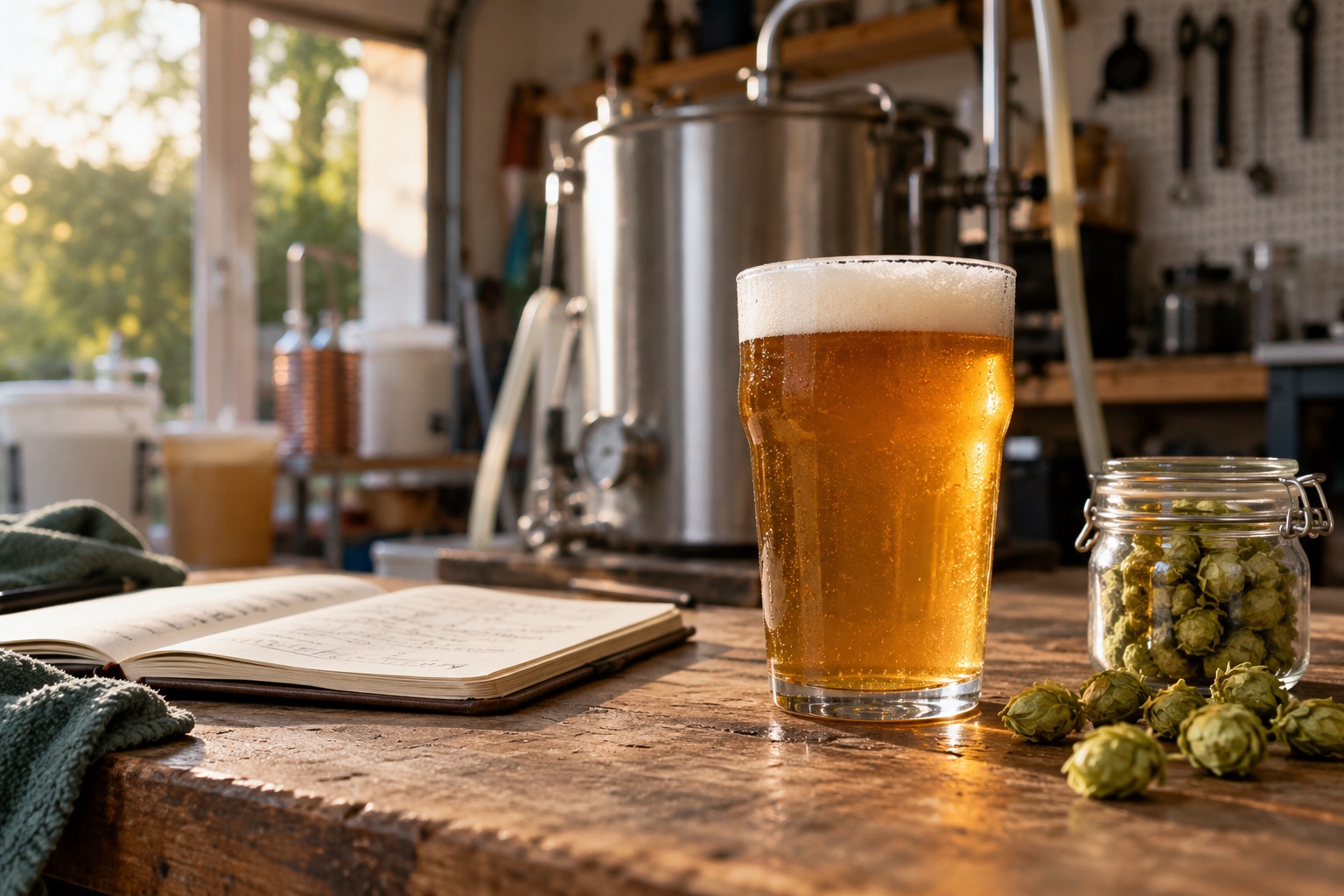
American pale ale is sometimes introduced as IPA’s quieter cousin. That sells it short. A good pale ale is its own trick: bright hop character, firm bitterness, and a malt base that holds the whole thing upright without asking for applause.
The BJCP 2021 guidelines describe the style as refreshing and hop-forward, with enough malt to keep the beer balanced and drinkable. The published range is broad enough to allow a citrusy classic, a piney throwback, or something built around newer fruit-forward varieties. The recipe here stays close to the American template, pairing Cascade and Centennial with a clean fermentation, because it makes a useful baseline.
What you are aiming for
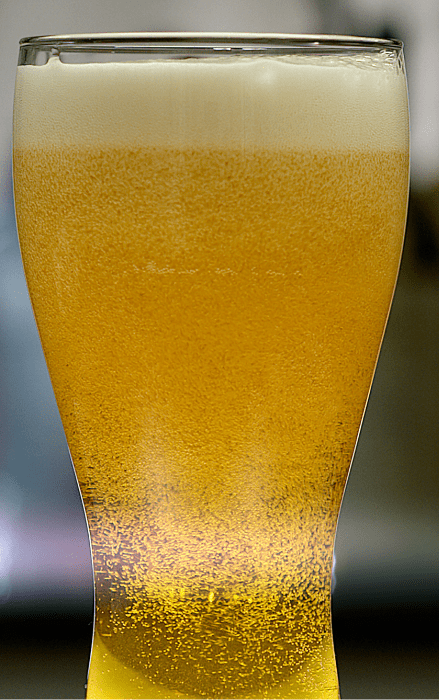
Pour the finished beer and you should see deep gold to light amber, with a sturdy white head. The first impression should be fresh hops: grapefruit peel, flowers, and a little resin. Malt belongs underneath, tasting lightly of toast and bread crust. Bitterness should clean up the sip without sanding your tongue.
The target numbers sit comfortably inside BJCP 18B:
- Original gravity: 1.052 (BJCP: 1.045–1.060)
- Final gravity: 1.011 (BJCP: 1.010–1.015)
- Alcohol: 5.4% ABV (BJCP: 4.5–6.2%)
- Bitterness: 38 IBU (BJCP: 30–50 IBU)
- Color: 7 SRM (BJCP: 5–10 SRM)
Those are guardrails, not a substitute for tasting. A 38 IBU beer with a rough boil addition can seem more bitter than a mathematically stronger beer with a smoother hop schedule.
The grain bill: give the hops a floor
The base is 8.25 lb (3.742 kg) of American pale malt. Munich malt contributes 0.75 lb (340 g) of bread crust, while 0.5 lb (227 g) of medium crystal malt adds color and a small caramel note. Keep the crystal restrained. More would make the finish sweet and blur the hop character we are trying to study.
Mash at 152°F for 60 minutes. That gives us a wort fermentable enough to finish crisp, but it does not turn the beer thin. If your system consistently attenuates farther than the recipe predicts, raise the rest a degree or two on the next batch rather than reaching for dextrin malt immediately.
The hop schedule: separate bitterness from aroma
Cascade at 60 minutes provides most of the bitterness. Centennial at 15 minutes builds citrus flavor, and Cascade at five minutes leaves a fresh top note. The dry hop is deliberately modest: 1 oz (28 g) each of Cascade and Centennial for three days.
That schedule gives each addition a clear job. It is also easy to modify. Brew it once, then replace only the late hops on the next batch. You will learn more from that controlled change than from throwing five fashionable varieties into the kettle and hoping they introduce themselves.
Hop alpha acids vary from lot to lot. The BeerXML file uses 6% for Cascade and 10% for Centennial. Update those values in your brewing software to match the packages in your hand, then let the software recalculate the bittering addition.
Water: adjust from a measurement, not a recipe card
For this beer, favor sulfate over chloride to sharpen the finish, but do not copy a list of salt additions without knowing your starting water. Salt amounts that work in soft water can push already mineral-heavy water well past pleasant. The American Homebrewers Association’s water primer is a useful starting point for understanding how mash pH and mineral balance affect the brew.
If you use reverse-osmosis water, a practical target is roughly 75 ppm calcium, 150 ppm sulfate, and 75 ppm chloride. If you use tap water, get a current report or test it before calculating additions. Aim for a room-temperature mash pH around 5.2–5.4.
Fermentation: clean is an active choice
Chill to 64°F, oxygenate, and pitch one properly rehydrated 11.5 g sachet of a clean American ale yeast such as US-05. Hold near 64°F for the first three days, then allow the beer to rise to 68°F to finish. Do not package on a calendar. Confirm that gravity is stable over two readings.
Add the dry hops after primary fermentation has slowed, leave them for three days, then package. Longer contact is not automatically more aromatic and can pull more vegetal material into the beer.
Carbonate to about 2.4 volumes of CO₂. At that level the beer feels lively, supports the hop aroma, and remains easy to pour.
Make the second batch more useful than the first
Take notes on three things: whether the bitterness feels smooth or coarse, whether the malt is noticeable in the middle of the sip, and which hop aroma appears first. Change one variable on the next batch. A different dry-hop variety, a slightly lower mash temperature, or a 10 IBU shift will teach you something. Changing all three will mostly teach you that the new beer is different.
BREW SHEET · BEERXML
Workbench American Pale Ale
American Pale Ale
Download BeerXML- Batch
- 18.93 L
- OG
- 1.052
- FG
- 1.011
- Boil
- 60 min
Fermentables
| Ingredient | Amount | Details |
|---|---|---|
| American Pale Malt | 3.74 kg | Grain |
| Munich Malt | 340 g | Grain |
| Crystal 40L | 227 g | Grain |
Hops
| Ingredient | Amount | Addition |
|---|---|---|
| Cascade | 31 g | Boil · 60 min · 6% alpha acid |
| Centennial | 21 g | Boil · 15 min · 10% alpha acid |
| Cascade | 28 g | Boil · 5 min · 6% alpha acid |
| Cascade | 28 g | Dry Hop · 3 min · 6% alpha acid |
| Centennial | 28 g | Dry Hop · 3 min · 10% alpha acid |
Yeast
| Ingredient | Amount | Details |
|---|---|---|
| SafAle US-05 | 11.5 g | Fermentis |
Mash schedule
- Saccharification · 66.7 °C · 60 min · 14.2 L infusion
Fermentation
- Primary: 10 days at 18 °C
Brewer’s notes
A balanced American pale ale designed as a hop-learning baseline. Adjust hop alpha values and equipment losses in brewing software before brew day.
Full technical details
Original export fields, ingredient specifications, water, style and equipment.
Fermentables
American Pale Malt
- Name
- American Pale Malt
- Type
- Grain
- Amount (kg / L for liquids)
- 3.742
- Yield
- 80.0
- Color (SRM)
- 2.0
- Origin
- United States
Munich Malt
- Name
- Munich Malt
- Type
- Grain
- Amount (kg / L for liquids)
- 0.340
- Yield
- 77.0
- Color (SRM)
- 8.0
Crystal 40L
- Name
- Crystal 40L
- Type
- Grain
- Amount (kg / L for liquids)
- 0.227
- Yield
- 74.0
- Color (SRM)
- 40.0
Hops
Cascade
- Name
- Cascade
- Origin
- United States
- Alpha acid (%)
- 6.0
- Amount (kg / L for liquids)
- 0.031
- Use
- Boil
- Time (min)
- 60.0
- Type
- Both
- Form
- Pellet
Centennial
- Name
- Centennial
- Origin
- United States
- Alpha acid (%)
- 10.0
- Amount (kg / L for liquids)
- 0.021
- Use
- Boil
- Time (min)
- 15.0
- Type
- Both
- Form
- Pellet
Cascade
- Name
- Cascade
- Origin
- United States
- Alpha acid (%)
- 6.0
- Amount (kg / L for liquids)
- 0.028
- Use
- Boil
- Time (min)
- 5.0
- Type
- Both
- Form
- Pellet
Cascade
- Name
- Cascade
- Origin
- United States
- Alpha acid (%)
- 6.0
- Amount (kg / L for liquids)
- 0.028
- Use
- Dry Hop
- Time (min)
- 3.0
- Type
- Both
- Form
- Pellet
Centennial
- Name
- Centennial
- Origin
- United States
- Alpha acid (%)
- 10.0
- Amount (kg / L for liquids)
- 0.028
- Use
- Dry Hop
- Time (min)
- 3.0
- Type
- Both
- Form
- Pellet
Yeast
SafAle US-05
- Name
- SafAle US-05
- Type
- Ale
- Form
- Dry
- Amount (kg / L for liquids)
- 0.0115
- Amount is weight
- true
- Laboratory
- Fermentis
- Attenuation (%)
- 81.0
- Min temperature
- 18.0
- Max temperature
- 28.0
Mash
- Name
- Single Infusion, Medium Body
- Grain temp
- 22.0
- Tun temp
- 22.0
- Sparge temp
- 76.0
Saccharification
- Name
- Saccharification
- Type
- Infusion
- Infusion water (L)
- 14.200
- Step time (min)
- 60.0
- Step temperature (°C)
- 66.7
- Ramp time
- 10.0
- End temp
- 66.7
Recipe details & fermentation
- Name
- Workbench American Pale Ale
- Type
- All Grain
- Brewer
- Homebrewing DIY
- Batch size (L)
- 18.927
- Boil size (L)
- 24.600
- Boil time (min)
- 60.0
- Efficiency (%)
- 75.0
- Notes
- A balanced American pale ale designed as a hop-learning baseline. Adjust hop alpha values and equipment losses in brewing software before brew day.
- Taste notes
- Grapefruit, floral and light resin over a restrained toast and caramel malt base. Firm, clean bitterness with a dry finish.
- Date
- 03 Oct 2026
- Original gravity
- 1.052
- Final gravity
- 1.011
- Carbonation
- 2.4
- Fermentation stages
- 1
- Primary duration (days)
- 10
- Primary temperature (°C)
- 18.0
Style details
- Name
- American Pale Ale
- Category
- Pale American Ale
- Category number
- 18
- Style letter
- B
- Style guide
- BJCP 2021
- Type
- Ale
- Og min
- 1.045
- Og max
- 1.060
- Fg min
- 1.010
- Fg max
- 1.015
- Ibu min
- 30.0
- Ibu max
- 50.0
- Color min
- 5.0
- Color max
- 10.0
- Abv min
- 4.5
- Abv max
- 6.2

No comments yet